Wind and Tidal Currents
Introduction
Wind is one of the most important weather factors affecting fishing, yet it is also one of the most misunderstood. Unlike tides, which are generated mainly by the gravitational pull of the Moon and the Sun, wind does not create tides. Instead, it modifies the movement of water, sometimes strengthening or weakening the tidal currents predicted by tide tables.Understanding whether wind is moving with, against or across the tidal current can help anglers interpret the conditions more accurately, choose suitable fishing techniques and make safer decisions on the water.
Tide determines the potential.
Wind determines the actual conditions.
The Moon determines the strength and timing of the tidal current, while the wind influences how that current is experienced on the water. Wind can strengthen or weaken the surface current, alter wave conditions, and affect boat drift. As a result, the actual fishing conditions often differ from those predicted by tide tables alone.
How Wind Creates Wind-Driven Currents
Wind transfers energy to the water through friction, a process known as wind stress. As the wind blows across the sea surface, it pushes the upper layer of water in the same direction. If the wind continues for many hours, a wind-driven surface current develops.Near the coast, persistent onshore winds push water towards the land, causing water to accumulate along the shoreline and slightly raising sea level. Offshore winds have the opposite effect by pushing surface water away from the coast.
Unlike tidal currents, which involve movement throughout much of the water column, wind-driven currents mainly affect the upper layers of the ocean. Consequently, wind has a much greater influence in shallow coastal waters than in deep offshore waters.
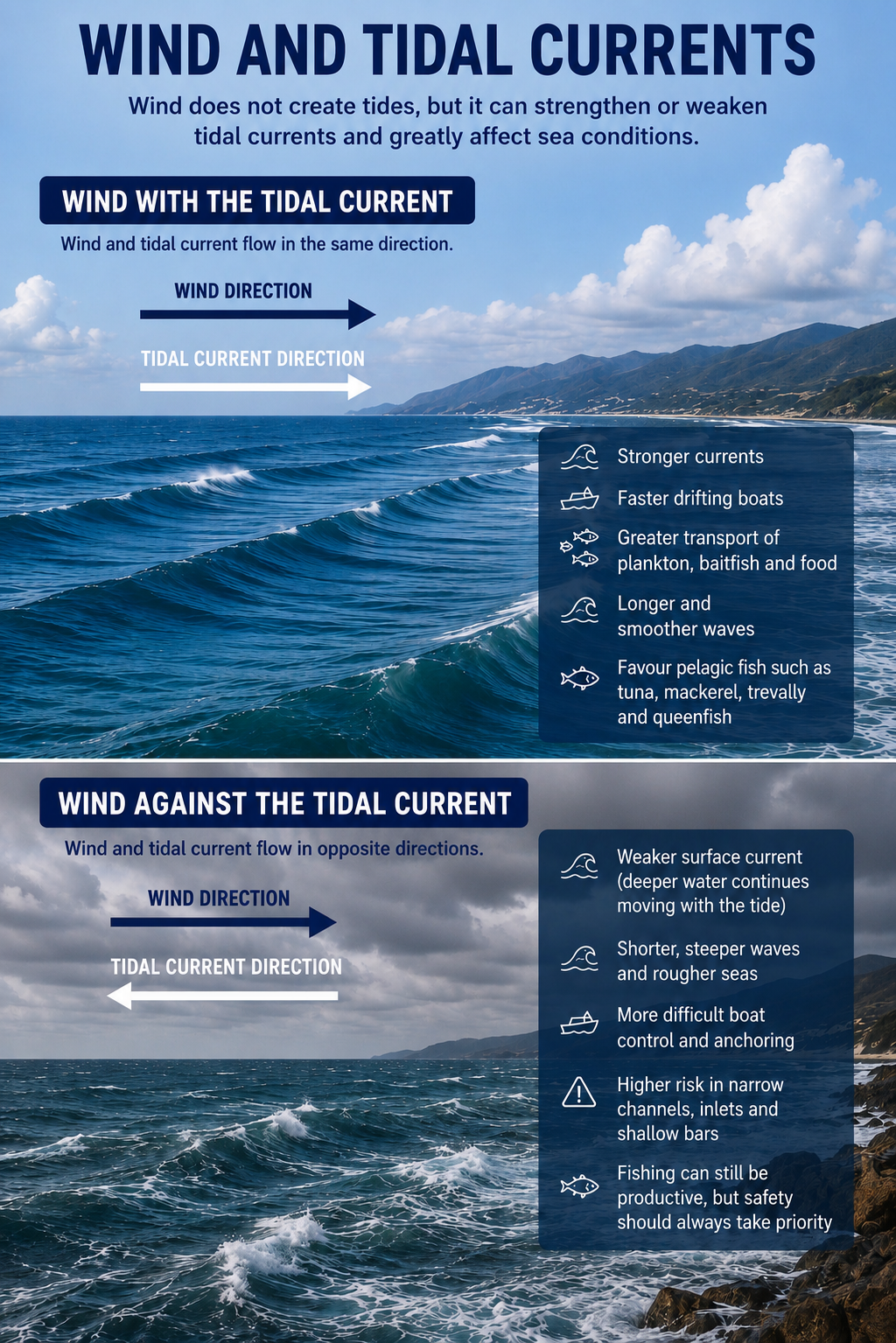
Wind Blowing With the Tidal Current
When wind-driven surface flow is in the same direction as the tidal current, the two flows can reinforce each other near the surface.This results in:
- Stronger currents.
- Faster drifting boats.
- Greater transport of plankton, baitfish and food.
- Longer and smoother waves.
In shallow coastal waters, the effect can be even greater when the natural afternoon sea breeze develops in the same direction as the tidal current, producing surface conditions that can differ noticeably from those predicted by tide tables.
However, stronger currents also require heavier sinkers for bottom fishing and may reduce bite sensitivity.
Wind Blowing Against the Tidal Current
When the wind opposes the tidal current, the effects are very different.The opposing forces compress the waves, producing short, steep seas that are uncomfortable and sometimes dangerous. Depending on the wind speed and water depth, the surface current may become weaker while deeper water continues moving with the tide.
For anglers, these conditions often mean:
- Rougher boat rides.
- More difficult anchoring.
- Reduced boat control while drifting.
- Increased risk when crossing river mouths or shallow bars.
Wind Blowing Across the Tidal Current
When wind crosses the tidal current at an angle, the two forces do not directly reinforce or oppose each other. Instead, the boat may experience sideways drift as wind pushes the surface while the current moves the water in another direction.For anglers, crosswinds can make boat positioning more difficult, particularly when trying to position over reefs, wrecks or narrow fishing grounds.
The Daily Sea Breeze Cycle
Along many tropical coastlines, wind direction changes naturally throughout the day.At night and during the early morning, the land cools faster than the sea. Air therefore flows from land towards the sea, producing a land breeze.
During the day, the land heats more rapidly than the sea. Warm air rises over land and cooler air from over the sea moves inland, creating a sea breeze.
Sea breezes are usually strongest during the afternoon and often explain why calm morning conditions gradually become windier later in the day.
If the afternoon sea breeze blows in the same direction as the tidal current, the current can become significantly stronger than predicted. If it blows against the tidal current, sea conditions may become rougher despite little change in the predicted tide.
Wind Effects by Fishing Location
Beaches
At beaches, the tidal current generally flows towards the shore during the flood tide and away from the shore during the ebb tide.When onshore winds blow with a flood tide, they reinforce the incoming current, pushing food, floating debris and baitfish towards the shoreline. These conditions can improve surf-fishing opportunities by bringing food and baitfish closer to the shoreline.
During an ebb tide, offshore winds reinforce the outgoing current, while onshore winds oppose it.
This effect is usually most noticeable on gently sloping sandy beaches.
Estuaries
In estuaries, the tidal current flows upstream during the flood tide and downstream during the ebb tide.Wind blowing in the same direction as the tidal current strengthens the flow, while opposing winds reduce the surface current and may create choppy conditions where the river meets the sea.
Narrow Channels
In river mouths, tidal inlets and passages between islands, water is forced through confined spaces.When wind blows with the tidal current, the already fast current becomes even stronger. When wind opposes the current, steep standing waves can develop, potentially making these areas hazardous for small boats.
Nearshore Reefs
The tidal current generally follows the local coastline or reef structure.Wind blowing with the current increases boat drift and bait movement. Crosswinds mainly affect boat positioning, often requiring frequent engine corrections to stay over productive fishing grounds.
Deep Offshore Waters
In deep offshore waters, the direction of tidal current is controlled mainly by regional tides rather than the local coastline.Wind has relatively little influence on the deep-water current itself but strongly affects surface drift, wave height and boat handling.
Fishing Implications
Different fishing techniques respond differently to wind and tidal currents.Bottom Fishing
Moderately strong tidal currents generally provide the best balance between bait movement and sinker control. Excessive current requires heavier sinkers and reduces bite sensitivity, while very weak currents often result in reduced fish activity.Pelagic Fishing
Pelagic species such as tuna, mackerel, trevally and queenfish often become more active in stronger currents where baitfish are concentrated. Wind blowing with the current can further enhance bait movement.Slow Jigging
Slow jigging is highly dependent on both current and boat drift. Moderate to strong tidal currents usually provide the best jig action. Excessive wind increases drift speed, making it difficult to keep jigs near the bottom, while wind opposing the current often causes an unnatural jigging angle and poorer lure control.Drift Fishing
Both wind and tidal current determine the boat’s drift speed. When they flow in the same direction, the drift becomes faster. Crosswinds push the boat sideways, making it harder to stay over productive areas.Casting
Casting accuracy decreases as wind strength increases, particularly when using lightweight lures. Crosswinds also alter lure presentation and reduce casting distance.Beach Fishing
Gentle onshore winds often push food and baitfish towards the shore, improving beach fishing. Strong onshore winds, however, can produce heavy surf, while offshore winds generally create calmer water but may reduce fish activity close to shore.Practical Tips
Before leaving home, anglers can make a quick assessment of the expected conditions by following three simple steps.Step 1 – Estimate the tidal current direction.
Determine whether the location will be experiencing a flood tide (incoming tide) or an ebb tide (outgoing tide) during the period you intend to fish.Step 2 – Check the wind forecast.
Use a weather app to identify the predicted wind direction and wind speed during the period you intend to fish.Step 3 – Compare the wind with the tidal current.
- Wind with the current → stronger current, smoother seas and faster drift.
- Wind against the current → steeper waves, rougher seas and more difficult boat handling.
- Crosswind → sideways drift and more difficult boat positioning.
Reading Wind and Current on the Water
Once on the fishing grounds, anglers can often confirm these conditions without any instruments.When a boat is anchored, the boat usually aligns itself with the wind, while the fishing line beneath the boat aligns with the tidal current. By comparing the direction of the boat with the direction of the fishing line, anglers can estimate how the wind and current are interacting.
If the line trails directly behind the boat, the wind and current are flowing in similar directions. If the fishing line points to the front of the boat, the wind is opposing the current. When they form a noticeable angle, a crosswind is influencing the boat’s position.
This simple observation is one of the easiest ways to understand actual conditions on the water.
Conclusion
Wind does not create tides, but it can significantly modify the tidal current and the conditions experienced on the water.Understanding how wind interacts with the Moon-driven tides allows anglers to better predict fish behaviour, choose the right fishing technique and, most importantly, make safer decisions on the water.
Tide determines the potential.
Wind determines the actual conditions.
By combining tide forecasts, wind forecasts and local knowledge, anglers can make more informed decisions and greatly improve both their fishing success and their safety on the water.