Dragonets
Dragonets are small, colourful benthic fishes belonging to the family Callionymidae, occurring mainly in the tropical Indo-West Pacific. They are recognised by their vivid colours and intricate body patterns, large fan-like pelvic fins and the stout preopercular spine projecting from the rear edge of the cheek.
Many dragonets exhibit pronounced sexual dimorphism. Males are usually more brightly coloured than females and often possess greatly elongated first dorsal fin rays used during courtship displays. Unlike most fishes, the blue colour of mandarinfishes is produced by specialised pigment cells rather than structural coloration, making them one of the few vertebrates with true blue pigmentation.
Dragonets lack normal scales and are protected by a thick mucus coating, which helps reduce parasite infections and is believed to discourage predators. In many species this mucus also contains toxic compounds and has a distinctive unpleasant smell, giving rise to the common name “stinkfish”.
Dragonets inhabit intertidal pools, sandy and muddy substrates, seagrass beds, lagoons and coral reefs, occurring from the surf zone to depths of about 800 m. Many species rest on the seabed and may partially bury themselves in sand when disturbed. They feed mainly on tiny benthic crustaceans, worms and other small invertebrates picked from the seabed. Most dragonets spawn at sunset. During courtship the male and female rise together above the seabed before simultaneously releasing eggs and sperm into the water column. The buoyant eggs drift with ocean currents until hatching.
Dragonets comprise over 200 recognised species placed in about 20 genera.
Many dragonets exhibit pronounced sexual dimorphism. Males are usually more brightly coloured than females and often possess greatly elongated first dorsal fin rays used during courtship displays. Unlike most fishes, the blue colour of mandarinfishes is produced by specialised pigment cells rather than structural coloration, making them one of the few vertebrates with true blue pigmentation.
Dragonets lack normal scales and are protected by a thick mucus coating, which helps reduce parasite infections and is believed to discourage predators. In many species this mucus also contains toxic compounds and has a distinctive unpleasant smell, giving rise to the common name “stinkfish”.
Dragonets inhabit intertidal pools, sandy and muddy substrates, seagrass beds, lagoons and coral reefs, occurring from the surf zone to depths of about 800 m. Many species rest on the seabed and may partially bury themselves in sand when disturbed. They feed mainly on tiny benthic crustaceans, worms and other small invertebrates picked from the seabed. Most dragonets spawn at sunset. During courtship the male and female rise together above the seabed before simultaneously releasing eggs and sperm into the water column. The buoyant eggs drift with ocean currents until hatching.
Dragonets comprise over 200 recognised species placed in about 20 genera.
Scientific Name: Synchiropus splendidus (Herre, 1927)
English Name: Mandarinfish, Mandarin Goby, Mandarin Dragonet, Green Mandarin, Green Dragonet, Striped Mandarinfish, Striped Dragonet, Psychedelic Mandarinfish
Chinese Name | 鱼类中文名: 花斑连鳍䲗 (Huā bān lián qí xián), 花斑翼连鳍䲗 (Huā bān yì lián qí xián), 麒麟鱼 (Qílín yú), 青蛙鱼 (Qīngwā yú)
Japanese Name | 和名: ニシキテグリ (Nishiki-teguri)
Malay Name | Nama Melayu Malaysia: Ikan Bebaji, Bebaji Batik
Thai Name | ชื่อสามัญภาษาไทย: ปลาแมนดาริน (Plā mæn dā rin)
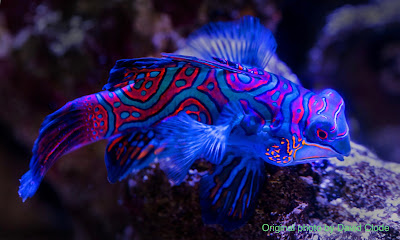
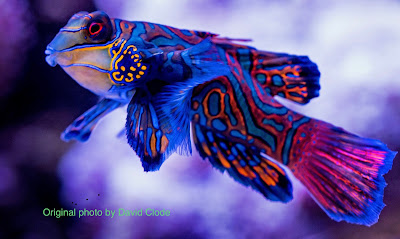
Main Identification Features: Bright blue, orange and green body with maze-like markings; large fan-shaped pelvic fins; short snout; males possess a greatly elongated first dorsal fin.
Size: Maximum total length 7 cm.
Habitat and Ecology: Shallow coral reefs to depths of about 18 m. Usually encountered alone, in pairs or as a harem consisting of one male and several females. They feed continuously throughout the day on tiny benthic crustaceans such as copepods, amphipods, ostracods and small worms.
Remarks: Its spectacular colours have made it one of the world’s most sought-after marine aquarium fishes. However, owing to its specialised diet of tiny benthic invertebrates, the Mandarinfish is considered one of the more difficult marine aquarium fishes to maintain successfully.
English Name: Mandarinfish, Mandarin Goby, Mandarin Dragonet, Green Mandarin, Green Dragonet, Striped Mandarinfish, Striped Dragonet, Psychedelic Mandarinfish
Chinese Name | 鱼类中文名: 花斑连鳍䲗 (Huā bān lián qí xián), 花斑翼连鳍䲗 (Huā bān yì lián qí xián), 麒麟鱼 (Qílín yú), 青蛙鱼 (Qīngwā yú)
Japanese Name | 和名: ニシキテグリ (Nishiki-teguri)
Malay Name | Nama Melayu Malaysia: Ikan Bebaji, Bebaji Batik
Thai Name | ชื่อสามัญภาษาไทย: ปลาแมนดาริน (Plā mæn dā rin)
Main Identification Features: Bright blue, orange and green body with maze-like markings; large fan-shaped pelvic fins; short snout; males possess a greatly elongated first dorsal fin.
Size: Maximum total length 7 cm.
Habitat and Ecology: Shallow coral reefs to depths of about 18 m. Usually encountered alone, in pairs or as a harem consisting of one male and several females. They feed continuously throughout the day on tiny benthic crustaceans such as copepods, amphipods, ostracods and small worms.
Remarks: Its spectacular colours have made it one of the world’s most sought-after marine aquarium fishes. However, owing to its specialised diet of tiny benthic invertebrates, the Mandarinfish is considered one of the more difficult marine aquarium fishes to maintain successfully.