Barbeled Grunters (Velvetchins)
Barbeled Grunters (family Hapalogenyidae), also known as Velvetchins, are marine reef fishes found throughout the Indo-West Pacific. They are recognised by their deep, laterally compressed bodies, numerous papillae and barbels on the chin, and the prominent dorsal fin bearing 11 strong spines and an anal fin with 3 spines.
Most species inhabit coastal reefs and rocky bottoms where they forage over the seabed for crustaceans, worms and small fishes. Their distinctive fleshy barbels and papillae beneath the chin are used to detect prey hidden on or within the seabed. Although generally uncommon, they are occasionally caught using handlines, bottom longlines and fish traps.
The family contains a single genus, Hapalogenys, with about seven recognised species. Two species occur in Malaysian waters. Modern molecular studies have confirmed that Hapalogenys is distinct from the grunters and sweetlips (family Haemulidae), and it is now placed in its own family, Hapalogenyidae.
Most species inhabit coastal reefs and rocky bottoms where they forage over the seabed for crustaceans, worms and small fishes. Their distinctive fleshy barbels and papillae beneath the chin are used to detect prey hidden on or within the seabed. Although generally uncommon, they are occasionally caught using handlines, bottom longlines and fish traps.
The family contains a single genus, Hapalogenys, with about seven recognised species. Two species occur in Malaysian waters. Modern molecular studies have confirmed that Hapalogenys is distinct from the grunters and sweetlips (family Haemulidae), and it is now placed in its own family, Hapalogenyidae.
Scientific Name: Hapalogenys analis Richardson, 1845
English Name: Belted Barbeled Grunter, Broadbanded Velvetchin
Chinese Name | 鱼类中文名: 华髭鲷 (Huá zī diāo), 臀斑髭鲷 (Tún bān zī diāo)
Japanese Name | 和名: セトダイ (Setodai)
Malay Name | Nama Bahasa Melayu Malaysia: Ikan Kaci Belang, Tebal Bibir
Main Identification Features: Deep-bodied fish with a fleshy lower lip bearing numerous short papillae and barbels. Body crossed by 5–7 alternating pale and dark brown vertical bands. Soft dorsal, anal and caudal fins have a distinctive black margin. Dorsal fin with 11 spines, preceded by an antrorse spine under skin, and 15 or 16 soft rays. Anal fin with 3 spines, second spine long and strong, and 9 soft rays.
Size: Maximum total length about 30 cm, commonly to 20 cm.
Habitat and Ecology: Occurs in coastal reefs and rocky inshore waters at depths of about 20–100 m. Feeds mainly on benthic crustaceans, worms and small fishes.
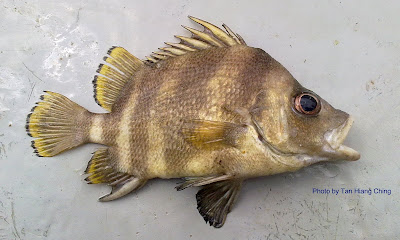
English Name: Belted Barbeled Grunter, Broadbanded Velvetchin
Chinese Name | 鱼类中文名: 华髭鲷 (Huá zī diāo), 臀斑髭鲷 (Tún bān zī diāo)
Japanese Name | 和名: セトダイ (Setodai)
Malay Name | Nama Bahasa Melayu Malaysia: Ikan Kaci Belang, Tebal Bibir
Main Identification Features: Deep-bodied fish with a fleshy lower lip bearing numerous short papillae and barbels. Body crossed by 5–7 alternating pale and dark brown vertical bands. Soft dorsal, anal and caudal fins have a distinctive black margin. Dorsal fin with 11 spines, preceded by an antrorse spine under skin, and 15 or 16 soft rays. Anal fin with 3 spines, second spine long and strong, and 9 soft rays.
Size: Maximum total length about 30 cm, commonly to 20 cm.
Habitat and Ecology: Occurs in coastal reefs and rocky inshore waters at depths of about 20–100 m. Feeds mainly on benthic crustaceans, worms and small fishes.