Billfishes
Billfishes are large pelagic predatory fishes of the Istiophoridae family found throughout tropical and subtropical seas worldwide. They are among the fastest and most powerful fishes in the oceans and include marlins and sailfishes.
Billfishes are characterised by their elongated spear-like upper jaw, streamlined body and large forked tail. Their dorsal and anal fins can be folded into grooves along the body to improve streamlining during high-speed swimming. The family members are also distinguished by a pair of keels on each side of the caudal base and a small shallow notch on both the upper and lower profiles of the caudal peduncle.
Billfishes are mostly found near the surface of waters where they feed primarily on schooling fishes, squids and crustaceans. They are highly migratory oceanic predators and are widely regarded as premier sport fishes.
There are 11 species in 5 genera worldwide. In Malaysian waters, 5 species belonging to 3 genera have been recorded.
Billfishes are characterised by their elongated spear-like upper jaw, streamlined body and large forked tail. Their dorsal and anal fins can be folded into grooves along the body to improve streamlining during high-speed swimming. The family members are also distinguished by a pair of keels on each side of the caudal base and a small shallow notch on both the upper and lower profiles of the caudal peduncle.
Billfishes are mostly found near the surface of waters where they feed primarily on schooling fishes, squids and crustaceans. They are highly migratory oceanic predators and are widely regarded as premier sport fishes.
There are 11 species in 5 genera worldwide. In Malaysian waters, 5 species belonging to 3 genera have been recorded.
Scientific Name: Istiompax indica (Cuvier, 1832)
English Name: Black Marlin
Chinese Name | 鱼类中文名: 黑旗鱼 (Hēi qí yú), 马林鱼 (Mǎ lín yú)
Malay Name | Nama Melayu Malaysia: Ikan Mersuji, Tumbuk Banir, Mersuji Hitam
Thai Name | ชื่อสามัญภาษาไทย: ปลากะโทงแทงดำ (Plā ka thong thæng dả), ปลากระโทงแทงด้า (Plāk ra thong thæng d̂ā)
Main Identification Features: A pair of keels on the caudal peduncle. Height of first dorsal fin shorter than highest body depth. Pectoral fins rigid. Second dorsal fin anterior to second anal fin.
Size: Maximum total length about 4.5 m. Maximum body weight about 700 kg.
Habitat and Ecology: Oceanic, highly migratory, and epipelagic. Often in waters close to coasts and islands. A visual predator, usually found at the upper layers of water above the thermocline. Dive into deeper waters during the day and feed on a wide variety of fishes, crustaceans, and cephalopods, but mostly on small tunas. Stay at surface waters at night.

Scientific Name: Istiophorus platypterus (Shaw, 1792)
English Name: Indo-Pacific Sailfish
Chinese Name | 鱼类中文名: 雨伞旗鱼 (Yǔsǎn qí yú), 雨伞马林, (Yǔsǎn mǎ lín), 东方旗鱼 (Dōngfāng qí yú)
Malay Name | Nama Melayu Malaysia: Mersuji, Ikan Layaran, Layaran Pasifik
Thai Name | ชื่อสามัญภาษาไทย: ปลากะโทงร่ม (Plā ka thong r̀m), ปลากระโทงแทงร่มอินโด-แปซิฟิก (Plāk ra thong thæng r̀m xin do-pæsifik)
Main Identification Features: Upper jaw elongated and spear-shaped. Dorsal fin greatly enlarged, sail-like with black spots. The dorsal fin is squared off in front and is highest in the middle. Pelvic fins extremely long and narrow.
Size: Maximum total length about 3.5 m. Maximum body weight about 100 kg.
Habitat and Ecology: Oceanic, highly migratory, and epipelagic. Often in waters close to coasts and islands. A visual predator, usually found at the upper layers of water above the thermocline. Dive into deeper waters during the day and feed on a wide variety of fishes, crustaceans, and cephalopods. Stay at surface waters at night.


Click button below to see more species info and photo.
More
Scientific Name: Kajikia audax (Philippi, 1887)
Synonym: Tetrapturus audax (Philippi, 1887)
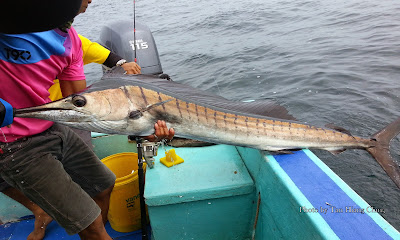
English Name: Striped Marlin
Chinese Name | 鱼类中文名: 红肉旗鱼 (Hóng ròu qí yú),箕作枪鱼 (Jīzuò qiāng yú), 马林鱼 (Mǎ lín yú)
Malay Name | Nama Melayu Malaysia: Ikan Marlin, Mersuji Tahil
Thai Name | ชื่อสามัญภาษาไทย: ปลากะโทงแทงลายบั้ง (Plā ka thong thæng lāy bậng), ปลากระโทงแทงลาย (Plāk ra thong thæng lāy)
Main Identification Features: Nape fairly elevated. Height of first dorsal fin higher than highest body depth. A pair of keels on the caudal peduncle. Pectoral fins falcate and flexible. Flanks with cobalt/bluish stripes. 1st dorsal fin dark blue, other fins dark brown, and anal fin bases with a tinge of silvery white.
Size: Maximum total length about 3.5 m; body weight to about 200 kg.
Habitat and Ecology: Oceanic and epipelagic. Often in waters far from coasts and islands. Mostly solitary, but form small schools during spawning season. A visual predator, usually found at the upper layers of water above the thermocline. Dive into deeper waters during the day and feed on a wide variety of fishes, crustaceans, and cephalopods. Stay at surface waters at night.

Click button below to see more species info and photo.
More
English Name: Black Marlin
Chinese Name | 鱼类中文名: 黑旗鱼 (Hēi qí yú), 马林鱼 (Mǎ lín yú)
Malay Name | Nama Melayu Malaysia: Ikan Mersuji, Tumbuk Banir, Mersuji Hitam
Thai Name | ชื่อสามัญภาษาไทย: ปลากะโทงแทงดำ (Plā ka thong thæng dả), ปลากระโทงแทงด้า (Plāk ra thong thæng d̂ā)
Main Identification Features: A pair of keels on the caudal peduncle. Height of first dorsal fin shorter than highest body depth. Pectoral fins rigid. Second dorsal fin anterior to second anal fin.
Size: Maximum total length about 4.5 m. Maximum body weight about 700 kg.
Habitat and Ecology: Oceanic, highly migratory, and epipelagic. Often in waters close to coasts and islands. A visual predator, usually found at the upper layers of water above the thermocline. Dive into deeper waters during the day and feed on a wide variety of fishes, crustaceans, and cephalopods, but mostly on small tunas. Stay at surface waters at night.

Scientific Name: Istiophorus platypterus (Shaw, 1792)
English Name: Indo-Pacific Sailfish
Chinese Name | 鱼类中文名: 雨伞旗鱼 (Yǔsǎn qí yú), 雨伞马林, (Yǔsǎn mǎ lín), 东方旗鱼 (Dōngfāng qí yú)
Malay Name | Nama Melayu Malaysia: Mersuji, Ikan Layaran, Layaran Pasifik
Thai Name | ชื่อสามัญภาษาไทย: ปลากะโทงร่ม (Plā ka thong r̀m), ปลากระโทงแทงร่มอินโด-แปซิฟิก (Plāk ra thong thæng r̀m xin do-pæsifik)
Main Identification Features: Upper jaw elongated and spear-shaped. Dorsal fin greatly enlarged, sail-like with black spots. The dorsal fin is squared off in front and is highest in the middle. Pelvic fins extremely long and narrow.
Size: Maximum total length about 3.5 m. Maximum body weight about 100 kg.
Habitat and Ecology: Oceanic, highly migratory, and epipelagic. Often in waters close to coasts and islands. A visual predator, usually found at the upper layers of water above the thermocline. Dive into deeper waters during the day and feed on a wide variety of fishes, crustaceans, and cephalopods. Stay at surface waters at night.


Click button below to see more species info and photo.
More
Scientific Name: Kajikia audax (Philippi, 1887)
Synonym: Tetrapturus audax (Philippi, 1887)
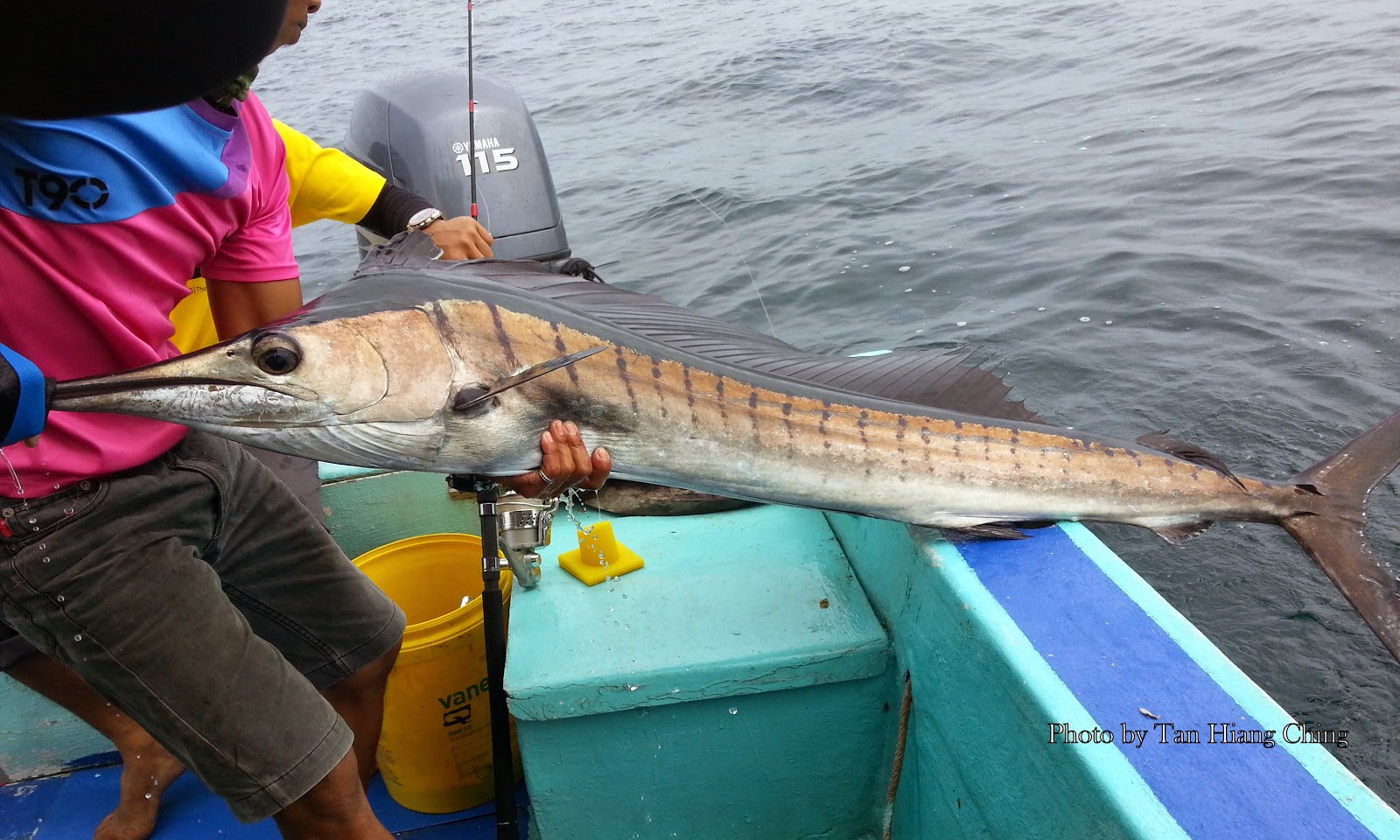
English Name: Striped Marlin
Chinese Name | 鱼类中文名: 红肉旗鱼 (Hóng ròu qí yú),箕作枪鱼 (Jīzuò qiāng yú), 马林鱼 (Mǎ lín yú)
Malay Name | Nama Melayu Malaysia: Ikan Marlin, Mersuji Tahil
Thai Name | ชื่อสามัญภาษาไทย: ปลากะโทงแทงลายบั้ง (Plā ka thong thæng lāy bậng), ปลากระโทงแทงลาย (Plāk ra thong thæng lāy)
Main Identification Features: Nape fairly elevated. Height of first dorsal fin higher than highest body depth. A pair of keels on the caudal peduncle. Pectoral fins falcate and flexible. Flanks with cobalt/bluish stripes. 1st dorsal fin dark blue, other fins dark brown, and anal fin bases with a tinge of silvery white.
Size: Maximum total length about 3.5 m; body weight to about 200 kg.
Habitat and Ecology: Oceanic and epipelagic. Often in waters far from coasts and islands. Mostly solitary, but form small schools during spawning season. A visual predator, usually found at the upper layers of water above the thermocline. Dive into deeper waters during the day and feed on a wide variety of fishes, crustaceans, and cephalopods. Stay at surface waters at night.

Click button below to see more species info and photo.
More