Snapper: Deepwater Longtail Red Snapper
Deepwater Longtail Red Snapper (Etelis coruscans) are large deepwater predatory snappers found throughout the Indo-Pacific Ocean. They inhabit rocky bottoms, steep underwater slopes and deep coral reef habitats at depths of about 90 to 500 metres and are highly prized food fishes in many parts of their range.
Deepwater Longtail Red Snappers can be recognised by their deep pink to bright red coloration, deeply forked caudal fin and elongated caudal-fin lobe in larger individuals. Their last soft dorsal and anal fin rays are also produced into slender trailing filaments, giving the species a distinctive appearance among the deepwater snappers.
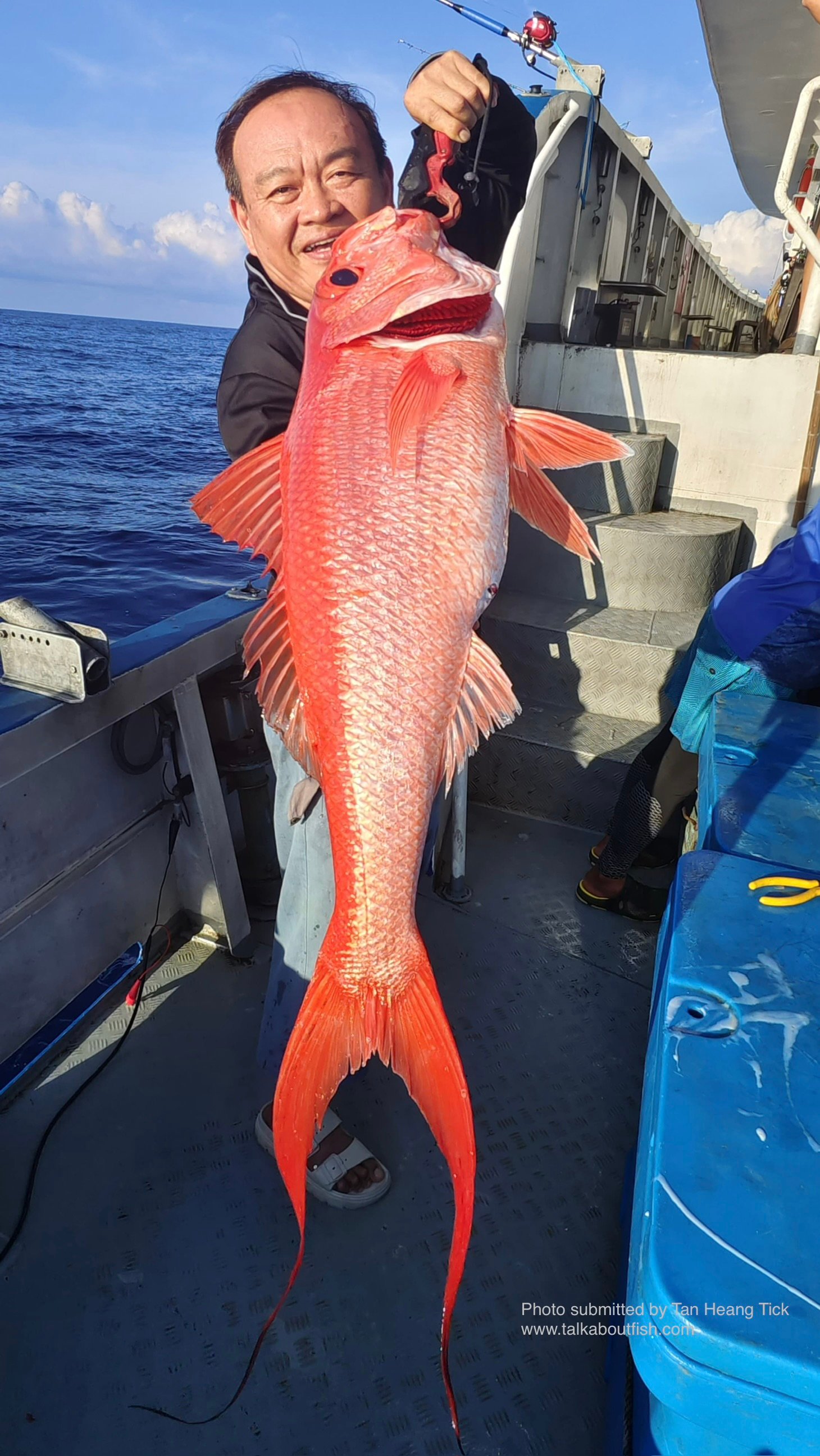

Deepwater Longtail Red Snapper is known by many different common names throughout its geographical range. In Hawaii, it is famously known as Onaga and is one of the most highly prized deepwater food fishes. Other English names include Flame Snapper and Scarlet Snapper. The common name Ruby Snapper is sometimes applied to this species, although it is more commonly associated with Etelis carbunculus.
The Chinese names include 红钻鱼 (Hóng Zuàn Yú), 红尾鸟 (Hóng Wěi Niǎo) and 长尾滨鲷 (Cháng Wěi Bīn Diāo). In Malaysia, the accepted Malay name is Kerisi-basi bara. It is sometimes also referred to as Ikan Kerisi Bali or Kerisi Basi, names that are commonly used for members of the Jobfishes (Etelinae).
Deepwater Longtail Red Snappers are primarily found deeper than 200 metres and are widely distributed from East Africa and southern Japan southward to Australia, Hawaii and several isolated oceanic islands throughout the Indo-Pacific. They feed mainly on small fishes, squids, shrimps and crabs and are commonly caught using deepwater handline techniques.
Two body forms are recognised in this species: long-tailed and short-tailed morphs. Both forms have been recorded from Fiji, where the short-tailed morph appears to be associated mainly with seamount habitats, while the long-tailed morph is more commonly encountered along island slopes. The exceptionally long caudal-fin lobe seen in some individuals gives rise to the species' common name.
Deepwater Longtail Red Snappers are somewhat slow-growing and relatively late to mature, taking about five to six years to reach sexual maturity. They can attain a maximum total length of about 120 cm and have been recorded to live for at least 18 years. Like many deepwater fishes, their life history characteristics make them more vulnerable to overfishing than many shallow-water reef fishes.
Deepwater Longtail Red Snappers are highly valued food fishes and support important commercial and recreational deepwater fisheries throughout much of their geographical range. Although the species is currently assessed as Least Concern by the IUCN Red List because of its wide distribution, localised population declines have been reported in heavily fished areas, highlighting the importance of sustainable management of deepwater fisheries.