Sandperches (Pinguipedidae)
Sandperches are members of the Pinguipedidae family. They are found along the Atlantic coasts of South America and Africa, and throughout the Indo-Pacific, including from eastern Africa to Hawaii, New Zealand and the waters off Chile. They inhabit sandy, muddy and rubble bottoms, often near coral reefs. They are recognized by their elongated dorsal fin with 4 or 5 spines and 20 to 24 soft rays, with the soft-rayed portion distinctly higher than the spinous portion. They also have an elongated anal fin with 1 spine and 16 to 20 soft rays. Their pelvic fins are inserted below or slightly in front of the pectoral-fin base. Most sandperches are distinctively patterned, although they are rarely brightly coloured.
Sandperches are bottom-dwelling predators that usually rest on the seabed while propping themselves up on their pelvic fins. They feed mainly on benthic crustaceans such as crabs and shrimps, although larger species also prey on small fishes. Most rely on camouflage to ambush passing prey and are generally easy to approach underwater.
The family Pinguipedidae contains 7 genera and about 90 species worldwide. In Malaysia, 2 genera and about 10 species are represented.
Sandperches are bottom-dwelling predators that usually rest on the seabed while propping themselves up on their pelvic fins. They feed mainly on benthic crustaceans such as crabs and shrimps, although larger species also prey on small fishes. Most rely on camouflage to ambush passing prey and are generally easy to approach underwater.
The family Pinguipedidae contains 7 genera and about 90 species worldwide. In Malaysia, 2 genera and about 10 species are represented.
Scientific Name: Parapercis xanthozona (Bleeker, 1849)
English Name: Yellowbar Sandperch
Chinese Name | 鱼类中文名: 红带拟鲈 (Hóng dài nǐ lú), 狗二魚 (Gǒu èr yú)
Malay Name | Nama Melayu Malaysia: Ikan Belukor, Gendang, Marabahan, Haruan-laut Ekor Tompok Putih
Thai Name | ชื่อสามัญภาษาไทย: ปลาตาแหงน (Plā tā h̄ængn)
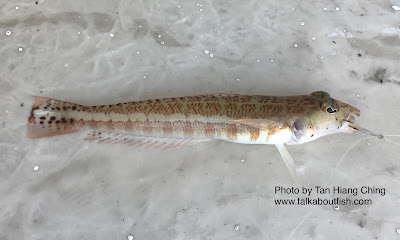
Main Identification Features: Midlateral white stripe on body extending nearly to end of caudal fin where bordered above and below by black spots. 6 double saddle-like markings along the back, 10 bars along the lower side.
Size: Maximum total length about 23 cm.
Habitat and Ecology: Rocky and coral reefs, 10 to 28 m depth. A benthic and territorial species. Usually solitary or in small harem-like groups. Feeds on invertebrates and small fishes.
English Name: Yellowbar Sandperch
Chinese Name | 鱼类中文名: 红带拟鲈 (Hóng dài nǐ lú), 狗二魚 (Gǒu èr yú)
Malay Name | Nama Melayu Malaysia: Ikan Belukor, Gendang, Marabahan, Haruan-laut Ekor Tompok Putih
Thai Name | ชื่อสามัญภาษาไทย: ปลาตาแหงน (Plā tā h̄ængn)
Main Identification Features: Midlateral white stripe on body extending nearly to end of caudal fin where bordered above and below by black spots. 6 double saddle-like markings along the back, 10 bars along the lower side.
Size: Maximum total length about 23 cm.
Habitat and Ecology: Rocky and coral reefs, 10 to 28 m depth. A benthic and territorial species. Usually solitary or in small harem-like groups. Feeds on invertebrates and small fishes.