White Pomfrets (Butterfishes)
Overview
White Pomfrets belong to the genus Pampus of the Stromateidae (Butterfishes) family. Many members of the Butterfishes family are highly prized food fishes and are found in tropical and temperate waters of the Atlantic, Indian and Pacific Oceans. They are distinguished by their deep and strongly compressed bodies, small mouths and eyes, silvery to bluish coloration, absence of pelvic fins, and lack of keels or scutes near the caudal fin.
White Pomfrets are highly regarded as food fishes throughout Asia and are prized for their soft, delicate and buttery flesh with relatively few fine bones. They are commonly prepared by steaming or in clear soups in many Asian cuisines, as these cooking methods preserve their natural sweetness and tender texture. Fresh specimens are often cooked with only minimal seasonings, allowing their delicate flavour to be fully appreciated.
White Pomfrets inhabit coastal and offshore waters, usually at depths shallower than 100 m. They are typically found in the mid-water column, forming small schools over sandy or muddy bottoms. Their diet consists mainly of zooplankton, including salps, ctenophores, medusae and other gelatinous organisms, as well as small benthic invertebrates.
Worldwide, there are 3 genera and about 16 species of Stromateidae. The genus Pampus currently comprises five recognised species distributed throughout the Indo-West Pacific region, with some species extending into the Western Pacific. The most commonly encountered species are Silver Pomfret (Pampus argenteus), Chinese Silver Pomfret (Pampus chinensis), Grey Pomfret (Pampus cinereus) and Southern Lesser Pomfret (Pampus minor).
White Pomfret Species
White Pomfret

Scientific Name: Pampus argenteus (Euphrasen, 1788)
English Name: Silver Pomfret, White Pomfret
French Name: Aileron argente
Chinese Name | 鱼类中文名: 白鲳 (Bái chāng), 银鲳 (Yín chāng)
Malay Name | Nama Melayu Malaysia: Ikan Bawal Putih, Duai Putih
Thai Name | ชื่อสามัญภาษาไทย: ปลาจะละเม็ดขาว (Plā calamĕd k̄hāw)
Local Hokkien: Pek Cheoh
Local Cantonese: Pak Chong
Main Identification Features: Fine ridge-like patch of skin on top of head large, extending above pectoral-fin base. Caudal fin deeply forked often with the lower lobe extended.
Size: Maximum standard length about 60 cm, commonly to 30 cm.
Habitat and Ecology: Benthopelagic, over sandy and muddy bottoms, to 80 m depth. Oceanodromous, migrate northward or southward according to the distribution of warm water currents thus, they migrate to the north during northern hemisphere summer and to the south in winter. Adults feed on ctenophores, salps, medusae, and other zooplankton groups.
Chinese Silver Pomfret

Scientific Name: Pampus chinensis (Euphrasen, 1788)
English Name: Chinese Silver Pomfret
French Name: Aileron chinois
Chinese Name | 鱼类中文名: 斗鲳 (Dòu chāng), 斗底白鯧 (Dòu dǐ bái chāng), 斗底 (Dòu dǐ)
Malay Name | Nama Melayu Malaysia: Ikan Bawal Tambak, Duai Tambak
Thai Name | ชื่อสามัญภาษาไทย: ปลาจะละเม็ดเทา (Plā calamĕd theā)
Local Hokkien: Tau Tae
Local Cantonese: Tau Taie Chong
Main Identification Features: Posterior margin of dorsal and anal fins not deeply indented. No blade-like spines before dorsal and anal fins. Caudal fin emargenate, not deeply forked and lobes are almost equal in length. Eye small.
Size: Maximum standard length about 40 cm, commonly to 20 cm.
Habitat and Ecology: Benthopelagic and amphidromous, over sandy and muddy bottoms, less than 100 m depth. A surface feeder that feeds actively at night on copepods, ctenophores, medusae, decapods and other zooplankton.
Grey Pomfret
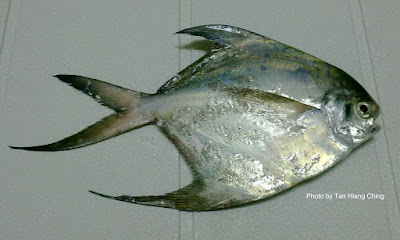
Scientific Name: Pampus cinereus (Bloch, 1795)
English Name: Grey Pomfret, Longfin Pomfret
Chinese Name | 鱼类中文名: 白鲳 (Bái chāng), 灰鲳 (Huī chāng)
Malay Name | Nama Melayu Malaysia: Ikan Bawal Tambak
Local Hokkien: Pek Cheoh
Local Cantonese: Pak Chong
Main Identification Features: Mouth subterminal and mouth slit curved downward posteriorly. Anterior rays of dorsal and anal fins produced distinct falcate lobes. Anal fin greatly extended and pectoral fin long, fan-like. Caudal fin deeply forked, the lower lobe usually longer than the upper lobe. Pectoral, anal, and caudal fins yellowish grey with dark margins posteriorly. Dorsal fin dark grey.
Habitat and Ecology: Benthopelagic, over sandy and muddy bottoms.