Pufferfishes
Pufferfishes are marine, brackish and freshwater fishes of the family Tetraodontidae, found throughout tropical and subtropical regions of the Atlantic, Indian and Pacific Oceans. They are best known for their ability to inflate their bodies by swallowing water or air when threatened and for their powerful beak-like jaws.
Pufferfishes are among the most poisonous fishes in the world. Most species contain tetrodotoxin, an extremely potent neurotoxin concentrated mainly in the liver, ovaries, intestines and skin. Toxicity varies among species and geographical regions, but many pufferfishes are highly poisonous and should not be consumed. Other related families, including porcupinefishes (Diodontidae) and boxfishes (Ostraciidae), possess different defensive adaptations and varying levels of toxicity.
Pufferfishes inhabit coral reefs, rocky reefs, estuaries, seagrass beds, mangroves and freshwater rivers. They feed mainly on hard-shelled invertebrates such as molluscs, crustaceans and sea urchins, using their powerful beak-like jaws to crush their prey. Some species also consume algae, seagrasses and other plant material.
The common English names for members of the family include pufferfishes, puffers, blowfishes, globe fishes and toadfishes. In Malaysia they are commonly known as ikan buntal.
There are approximately 200 species in 28 genera worldwide. More than 30 species have been recorded from Malaysian waters.
Pufferfishes are among the most poisonous fishes in the world. Most species contain tetrodotoxin, an extremely potent neurotoxin concentrated mainly in the liver, ovaries, intestines and skin. Toxicity varies among species and geographical regions, but many pufferfishes are highly poisonous and should not be consumed. Other related families, including porcupinefishes (Diodontidae) and boxfishes (Ostraciidae), possess different defensive adaptations and varying levels of toxicity.
Pufferfishes inhabit coral reefs, rocky reefs, estuaries, seagrass beds, mangroves and freshwater rivers. They feed mainly on hard-shelled invertebrates such as molluscs, crustaceans and sea urchins, using their powerful beak-like jaws to crush their prey. Some species also consume algae, seagrasses and other plant material.
The common English names for members of the family include pufferfishes, puffers, blowfishes, globe fishes and toadfishes. In Malaysia they are commonly known as ikan buntal.
There are approximately 200 species in 28 genera worldwide. More than 30 species have been recorded from Malaysian waters.
Scientific Name: Arothron immaculatus (Bloch & Schneider, 1801)
English Name: Immaculate Puffer, Immaculate Blowfish, Blackedged Blaasop
Malay Name | Nama Melayu Malaysia: Buntal Pasir Bersih
Thai Name | ชื่อสามัญภาษาไทย: ปลาปักเป้าหางไหม้ (Plā pạkpao h̄āng h̄ịm̂)
Main Identification Features: Body covered with prickles. No longitudinal dark stripes at the side of body. Caudal fin yellowish with dark rim.
Size: Maximum total length 37.5 cm.
Habitat and Ecology: Found from estuaries to coral reefs at depths of 3–30 m. Usually found solitary. Primarily carnivorous, but feeds on seagrasses and mangroves as well.
Remarks: Deemed poisonous. Do not eat.


Scientific Name: Arothron mappa (Lesson, 1831)
English Name: Map Puffer, Scribbled Pufferfish, Map Blaasop
Malay Name | Nama Melayu Malaysia: Buntal Pasir Corak
Thai Name | ชื่อสามัญภาษาไทย: ปลาปักเป้าลายแผนที่ (Plā pạkpao lāy p̄hænthī̀)
Main Identification Features: Fine lines radiating from the eye. Black reticulations below pectoral fin. Black blotch at the side of belly below the pectoral fin.
Size: Maximum total length 65 cm.
Habitat and Ecology: Coastal waters associated with coral reefs, from 4 to 30 m depth. Usually found solitary. Feeds on algae, sponges, and benthic invertebrates including corals.
Remarks: Highly poisonous. Do not eat.

Scientific Name: Arothron reticularis (Bloch & Schneider, 1801)
English Name: Reticulated Pufferfish, Reticulated Blowfish
Malay Name | Nama Melayu Malaysia: Buntal Pasir Batik
Bahasa Indonesia: Ikan Buntel Kelapa
Thai Name | ชื่อสามัญภาษาไทย: ปลาปักเป้าท้องลาย (Plā pạkpao tĥong lāy), ปลาปักเป้าลายตาข่าย (Plā pạkpao lāytā k̄h̀āy)
Main Identification Features: Body greenish-brown with white lines and spots. White lines around the eye and gill opening. Belly white with greenish-brown lines. Dorsal and anal fins yellowish. Pectoral fin yellowish with black base. Caudal fin yellowish brown with pale spots and dark margin.
Size: Maximum standard length 45 cm.
Habitat and Ecology: Estuarine and shallow coastal waters with coral reefs, seagrass beds, sandy and muddy bottoms, to 25 m depth. Juveniles found in estuaries and enter the lower reaches of streams. Usually found solitary. Feeds on corals, seagrass, molluscs, crustaceans, and other invertebrates.
Remarks: Deemed poisonous. Do not eat.


Scientific Name: Arothron stellatus (Anonymous, 1798)
English Name: Stellate Puffer, Starry Pufferfish, Black Lined Pufferfish, Diagonal Banded Toadfish
Malay Name | Nama Melayu Malaysia: Buntal Pasir Bintang
Thai Name | ชื่อสามัญภาษาไทย: ปลาปักเป้าก้นดำ (Plā pạkpao k̂n dả)
Main Identification Features: Displays differences in colour pattern at various stages of growth. Juveniles with small black spots and dark stripes that become spots with growth. Dark blotches around the bases of the pectoral fin. Adults with or without spots on fin.
Size: Maximum total length 120 cm, commonly to about 55 cm.
Habitat and Ecology: Coastal waters, from 3 to 58 m depth. Juveniles found inshore and enter estuaries. Usually found solitary. Feeds on sea urchins, sponges, crabs, coral and algae.
Remarks: Extremely poisonous. Do not eat.

Scientific Name: Dichotomyctere fluviatilis (Hamilton, 1822)
English Name: Green Pufferfish, Ceylon Pufferfish
Malay Name | Nama Melayu Malaysia: Ikan Buntal Gigi Hijau, Buntal Mas
Thai Name | ชื่อสามัญภาษาไทย: ปลาปักเป้าเขียว (Plā pạkpao k̄heīyw)
Main Identification Features: Dorsal profile arched, highest at midst of back. Three large dark transverse bands on back. Scattered large dark blotches surrounded by yellow borders on the back half of the body. Blotches are spaced out far apart.
Size: Maximum total length 18 cm.
Habitat and Ecology: Estuaries and the lower reaches of freshwater rivers. Usually inhabits brackish waters but also enters freshwater. Feeds on molluscs, crustaceans and other invertebrates, as well as vascular plants and detritus.
Remarks: Extremely poisonous. Do not eat.

Scientific Name: Dichotomyctere nigroviridis (Marion de Procé, 1822)
English Name: Spotted Green Pufferfish
Malay Name | Nama Melayu Malaysia: Ikan Buntal Gigi Kupang
Thai Name | ชื่อสามัญภาษาไทย: ปลาปักเป้าเขียวประดำ (Plā pạkpao k̄heīyw pra dả)
Main Identification Features: Back and sides with more or less regular, rounded spots, which are more or less evenly scattered, and only occasionally confluent, never forming broad blotches. Blotches are closely spaced.
Size: Maximum total length 17 cm.
Habitat and Ecology: Coastal waters, estuaries and the lower reaches of freshwater rivers. Feeds on molluscs, crustaceans and other invertebrates, as well as vascular plants and detritus.
Remarks: Extremely poisonous. Do not eat.

Scientific Name: Lagocephalus guentheri Miranda Ribeiro, 1915
English Name: Diamondback Puffer
Malay Name | Nama Melayu Malaysia: Buntal, Buntal Pisang
Thai Name | ชื่อสามัญภาษาไทย: ปลาปักเป้า (Plā pạkpao)
Main Identification Features: Spinule patch on the back does not reach the dorsal-fin origin. Caudal fin slightly lunate. Caudal fin extended middle rays posterior dusky to dark brownish with the dorsal and ventral tips white in colour. The dorsal side of the body brown with several dark bands crossing over the back; the first band between the eyes, the second above the gill opening, the third above the posterior part of the pectoral fin, the fourth encircling the dorsal-fin base, and a couple of small dark markings on the dorsal side of the caudal peduncle. Eyes are large rounded with an orbital edge at lower part.
Size: Maximum total length 26.0 cm.
Habitat and Ecology: Coastal and estuarine waters, over sandy or muddy bottoms, to 274 m depth. Feeds on a variety of marine invertebrates.
Remarks: Deemed poisonous. Do not eat.


Scientific Name: Lagocephalus lunaris (Bloch & Schneider, 1801)
English Name: Lunartail Puffer
Malay Name | Nama Melayu Malaysia: Buntal Kerisi, Buntal Pisang Kasar
Thai Name | ชื่อสามัญภาษาไทย: ปลาปักเป้าแถบเงินหลังหนาม (Plā pạkpao t̄hæb ngein h̄lạng h̄nām), ปลาปักเป้าเต็ม (Plā pạkpao tĕm)
Main Identification Features: Spinules on back extending from nape to the dorsal-fin base. Spinules pattern elliptical in shape. Body elongated. Caudal fin lunate. Dorsal metallic gold. Flank with broad silvery band from mouth until edge of caudal fin. Ventral white.
Size: Maximum total length 45 cm.
Habitat and Ecology: Coastal and estuarine waters, over seagrass beds, sandy or muddy bottoms, from 5 to 150 m depth. Feeds mainly on crustaceans (crabs and prawns). Diet also includes fishes, cephalopods (squids) and molluscs (particularly bivalves).
Remarks: Deemed poisonous. Do not eat.


Scientific Name: Lagocephalus spadiceus (Richardson, 1845)
English Name: Half-smooth Golden Pufferfish
Malay Name | Nama Melayu Malaysia: Buntal Kerisi, Buntal Pisang Muda
Thai Name | ชื่อสามัญภาษาไทย: ปลาปักเป้าแถบเงินหลังหนาม (Plā pạkpao t̄hæb ngein h̄lạng h̄nām), ปลาปักเป้าครึ่ง (Plā pạkpao khrụ̀ng)
Main Identification Features: Spinules on back extending from nape to about half way to dorsal-fin origin. The dorsal two-thirds of the caudal fin are dark yellow and the ventral one-third is white.
Size: Maximum total length 43.1 cm.
Habitat and Ecology: Coastal and estuarine waters, over sandy bottoms, from 3 to 200 m depth, but usually less than 50 m depth. Feeds on fishes, molluscs and crustaceans.
Remarks: Deemed poisonous. Do not eat.

Scientific Name: Lagocephalus suezensis Clark & Gohar, 1953
English Name: Suez Puffer, Pufferfish
Malay Name | Nama Melayu Malaysia: Buntal
Thai Name | ชื่อสามัญภาษาไทย: ปลาปักเป้า (Plā pạkpao)
Main Identification Features: Spinules extending dorsally to origin of the dorsal fin; ventrally to before the cloacae. Caudal fin lunate. Spots are found irregularly shaped of brown to grey in various sizes dorsally. A raised skin fold along the lower side of caudal peduncle.
Size: Maximum total length 18 cm.
Habitat and Ecology: Coastal and offshore waters, to 100 m depth, but usually less than 25 m depth. Feeds on fishes, molluscs and crustaceans.
Remarks: Deemed poisonous. Do not eat.

Other Lagocephalus species in the Indo-Pacific area:
Lagocephalus sceleratus (Gmelin, 1789) Silver-cheeked Toadfish - Grey to greenish colour with regular black spots above. Small spinules extending dorsally to origin of the dorsal fin; ventrally to before the cloacae. The base of pectoral fin wide and black in colour. Silver blotch in front and below of eye. Caudal fin lunate. - Extremely poisonous - Do not eat.
Lagocephalus lagocephalus (Linnaeus, 1758), the Oceanic Pufferfish - Colour is dark blue above with no spots. A silver blotch in front of eye. Pectoral, dorsal and anal fins are dark. Belly with small spinules. - Deemed poisonous. Do not eat.
English Name: Immaculate Puffer, Immaculate Blowfish, Blackedged Blaasop
Malay Name | Nama Melayu Malaysia: Buntal Pasir Bersih
Thai Name | ชื่อสามัญภาษาไทย: ปลาปักเป้าหางไหม้ (Plā pạkpao h̄āng h̄ịm̂)
Main Identification Features: Body covered with prickles. No longitudinal dark stripes at the side of body. Caudal fin yellowish with dark rim.
Size: Maximum total length 37.5 cm.
Habitat and Ecology: Found from estuaries to coral reefs at depths of 3–30 m. Usually found solitary. Primarily carnivorous, but feeds on seagrasses and mangroves as well.
Remarks: Deemed poisonous. Do not eat.


Scientific Name: Arothron mappa (Lesson, 1831)
English Name: Map Puffer, Scribbled Pufferfish, Map Blaasop
Malay Name | Nama Melayu Malaysia: Buntal Pasir Corak
Thai Name | ชื่อสามัญภาษาไทย: ปลาปักเป้าลายแผนที่ (Plā pạkpao lāy p̄hænthī̀)
Main Identification Features: Fine lines radiating from the eye. Black reticulations below pectoral fin. Black blotch at the side of belly below the pectoral fin.
Size: Maximum total length 65 cm.
Habitat and Ecology: Coastal waters associated with coral reefs, from 4 to 30 m depth. Usually found solitary. Feeds on algae, sponges, and benthic invertebrates including corals.
Remarks: Highly poisonous. Do not eat.

Scientific Name: Arothron reticularis (Bloch & Schneider, 1801)
English Name: Reticulated Pufferfish, Reticulated Blowfish
Malay Name | Nama Melayu Malaysia: Buntal Pasir Batik
Bahasa Indonesia: Ikan Buntel Kelapa
Thai Name | ชื่อสามัญภาษาไทย: ปลาปักเป้าท้องลาย (Plā pạkpao tĥong lāy), ปลาปักเป้าลายตาข่าย (Plā pạkpao lāytā k̄h̀āy)
Main Identification Features: Body greenish-brown with white lines and spots. White lines around the eye and gill opening. Belly white with greenish-brown lines. Dorsal and anal fins yellowish. Pectoral fin yellowish with black base. Caudal fin yellowish brown with pale spots and dark margin.
Size: Maximum standard length 45 cm.
Habitat and Ecology: Estuarine and shallow coastal waters with coral reefs, seagrass beds, sandy and muddy bottoms, to 25 m depth. Juveniles found in estuaries and enter the lower reaches of streams. Usually found solitary. Feeds on corals, seagrass, molluscs, crustaceans, and other invertebrates.
Remarks: Deemed poisonous. Do not eat.

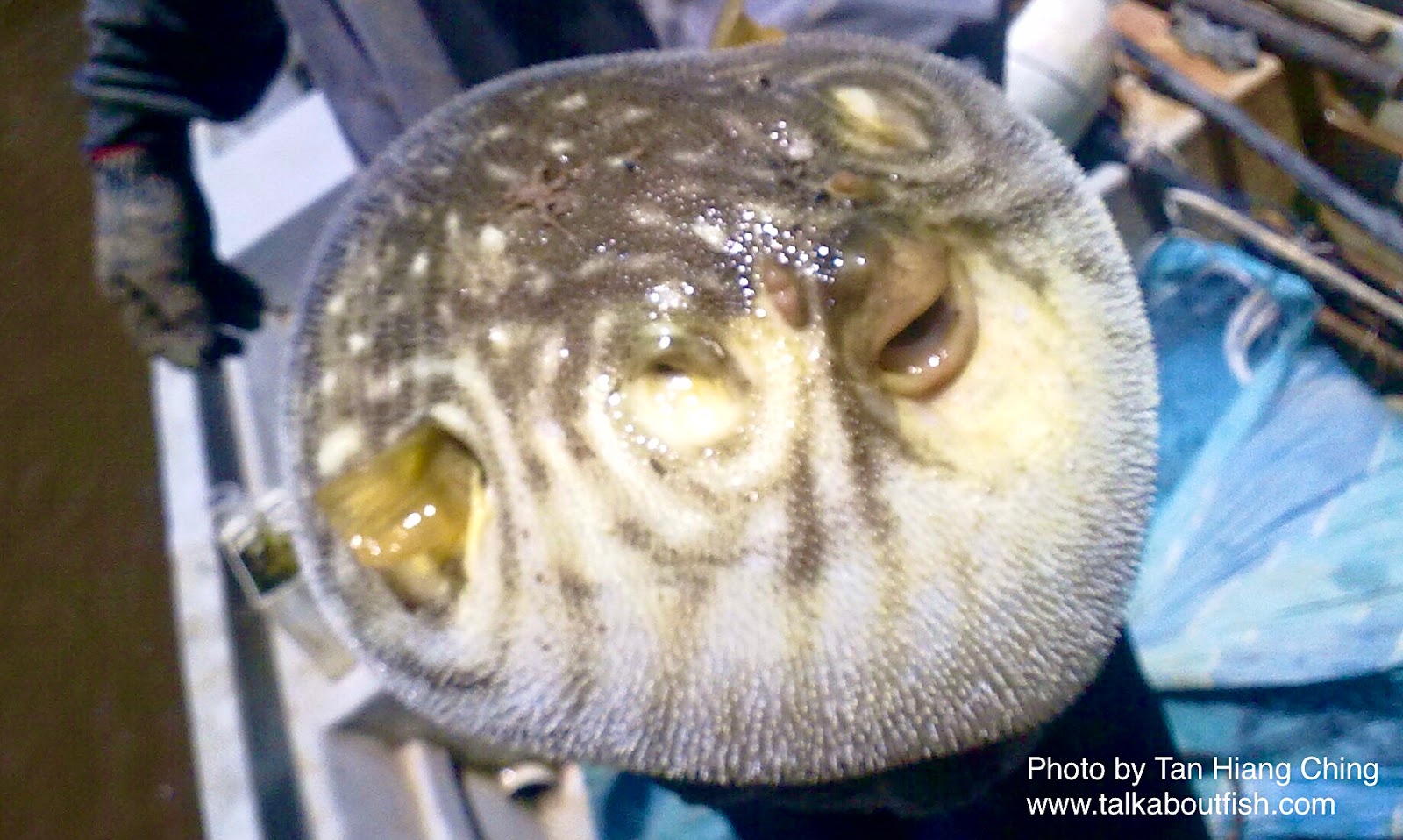
Scientific Name: Arothron stellatus (Anonymous, 1798)
English Name: Stellate Puffer, Starry Pufferfish, Black Lined Pufferfish, Diagonal Banded Toadfish
Malay Name | Nama Melayu Malaysia: Buntal Pasir Bintang
Thai Name | ชื่อสามัญภาษาไทย: ปลาปักเป้าก้นดำ (Plā pạkpao k̂n dả)
Main Identification Features: Displays differences in colour pattern at various stages of growth. Juveniles with small black spots and dark stripes that become spots with growth. Dark blotches around the bases of the pectoral fin. Adults with or without spots on fin.
Size: Maximum total length 120 cm, commonly to about 55 cm.
Habitat and Ecology: Coastal waters, from 3 to 58 m depth. Juveniles found inshore and enter estuaries. Usually found solitary. Feeds on sea urchins, sponges, crabs, coral and algae.
Remarks: Extremely poisonous. Do not eat.

Scientific Name: Dichotomyctere fluviatilis (Hamilton, 1822)
English Name: Green Pufferfish, Ceylon Pufferfish
Malay Name | Nama Melayu Malaysia: Ikan Buntal Gigi Hijau, Buntal Mas
Thai Name | ชื่อสามัญภาษาไทย: ปลาปักเป้าเขียว (Plā pạkpao k̄heīyw)
Main Identification Features: Dorsal profile arched, highest at midst of back. Three large dark transverse bands on back. Scattered large dark blotches surrounded by yellow borders on the back half of the body. Blotches are spaced out far apart.
Size: Maximum total length 18 cm.
Habitat and Ecology: Estuaries and the lower reaches of freshwater rivers. Usually inhabits brackish waters but also enters freshwater. Feeds on molluscs, crustaceans and other invertebrates, as well as vascular plants and detritus.
Remarks: Extremely poisonous. Do not eat.
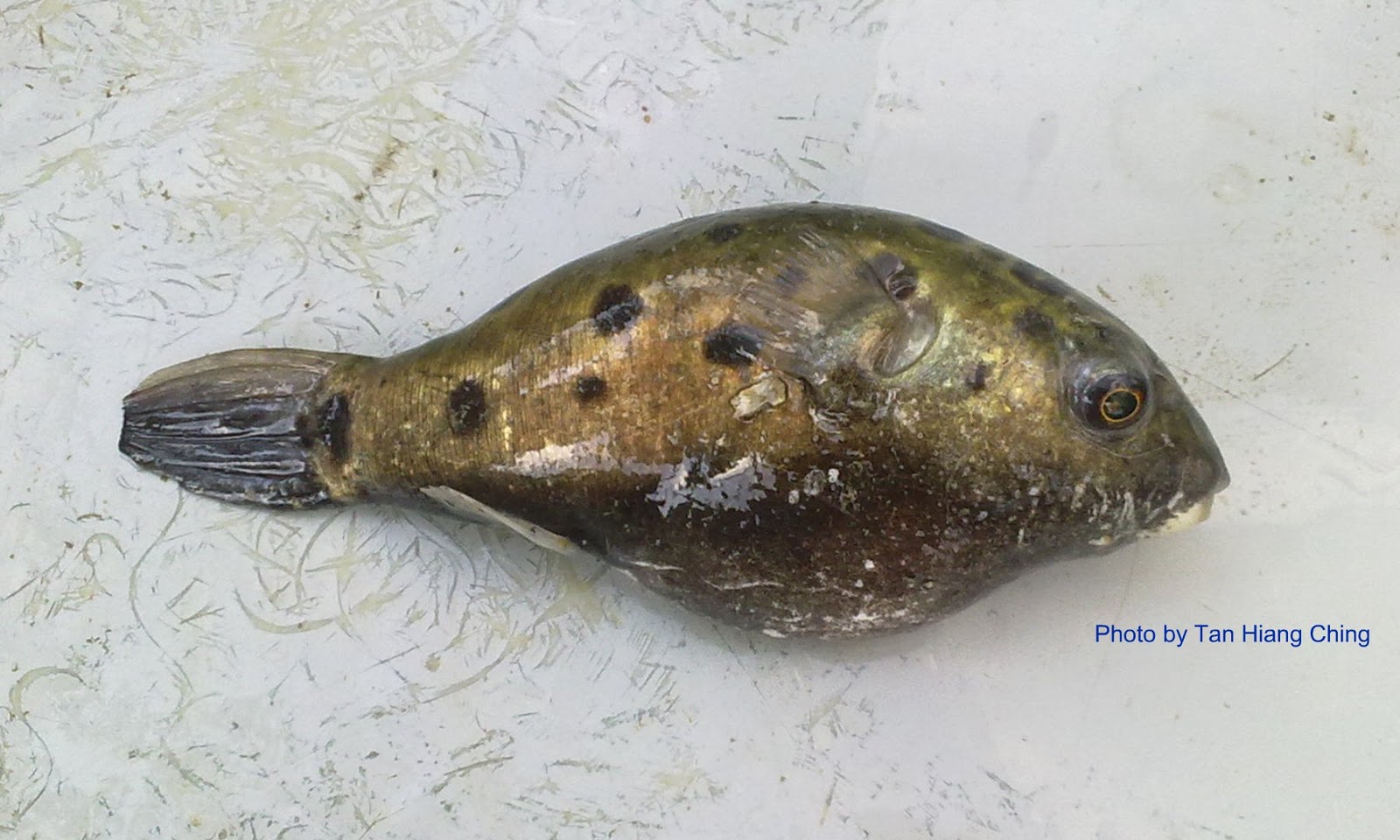
Scientific Name: Dichotomyctere nigroviridis (Marion de Procé, 1822)
English Name: Spotted Green Pufferfish
Malay Name | Nama Melayu Malaysia: Ikan Buntal Gigi Kupang
Thai Name | ชื่อสามัญภาษาไทย: ปลาปักเป้าเขียวประดำ (Plā pạkpao k̄heīyw pra dả)
Main Identification Features: Back and sides with more or less regular, rounded spots, which are more or less evenly scattered, and only occasionally confluent, never forming broad blotches. Blotches are closely spaced.
Size: Maximum total length 17 cm.
Habitat and Ecology: Coastal waters, estuaries and the lower reaches of freshwater rivers. Feeds on molluscs, crustaceans and other invertebrates, as well as vascular plants and detritus.
Remarks: Extremely poisonous. Do not eat.

Scientific Name: Lagocephalus guentheri Miranda Ribeiro, 1915
English Name: Diamondback Puffer
Malay Name | Nama Melayu Malaysia: Buntal, Buntal Pisang
Thai Name | ชื่อสามัญภาษาไทย: ปลาปักเป้า (Plā pạkpao)
Main Identification Features: Spinule patch on the back does not reach the dorsal-fin origin. Caudal fin slightly lunate. Caudal fin extended middle rays posterior dusky to dark brownish with the dorsal and ventral tips white in colour. The dorsal side of the body brown with several dark bands crossing over the back; the first band between the eyes, the second above the gill opening, the third above the posterior part of the pectoral fin, the fourth encircling the dorsal-fin base, and a couple of small dark markings on the dorsal side of the caudal peduncle. Eyes are large rounded with an orbital edge at lower part.
Size: Maximum total length 26.0 cm.
Habitat and Ecology: Coastal and estuarine waters, over sandy or muddy bottoms, to 274 m depth. Feeds on a variety of marine invertebrates.
Remarks: Deemed poisonous. Do not eat.


Scientific Name: Lagocephalus lunaris (Bloch & Schneider, 1801)
English Name: Lunartail Puffer
Malay Name | Nama Melayu Malaysia: Buntal Kerisi, Buntal Pisang Kasar
Thai Name | ชื่อสามัญภาษาไทย: ปลาปักเป้าแถบเงินหลังหนาม (Plā pạkpao t̄hæb ngein h̄lạng h̄nām), ปลาปักเป้าเต็ม (Plā pạkpao tĕm)
Main Identification Features: Spinules on back extending from nape to the dorsal-fin base. Spinules pattern elliptical in shape. Body elongated. Caudal fin lunate. Dorsal metallic gold. Flank with broad silvery band from mouth until edge of caudal fin. Ventral white.
Size: Maximum total length 45 cm.
Habitat and Ecology: Coastal and estuarine waters, over seagrass beds, sandy or muddy bottoms, from 5 to 150 m depth. Feeds mainly on crustaceans (crabs and prawns). Diet also includes fishes, cephalopods (squids) and molluscs (particularly bivalves).
Remarks: Deemed poisonous. Do not eat.


Scientific Name: Lagocephalus spadiceus (Richardson, 1845)
English Name: Half-smooth Golden Pufferfish
Malay Name | Nama Melayu Malaysia: Buntal Kerisi, Buntal Pisang Muda
Thai Name | ชื่อสามัญภาษาไทย: ปลาปักเป้าแถบเงินหลังหนาม (Plā pạkpao t̄hæb ngein h̄lạng h̄nām), ปลาปักเป้าครึ่ง (Plā pạkpao khrụ̀ng)
Main Identification Features: Spinules on back extending from nape to about half way to dorsal-fin origin. The dorsal two-thirds of the caudal fin are dark yellow and the ventral one-third is white.
Size: Maximum total length 43.1 cm.
Habitat and Ecology: Coastal and estuarine waters, over sandy bottoms, from 3 to 200 m depth, but usually less than 50 m depth. Feeds on fishes, molluscs and crustaceans.
Remarks: Deemed poisonous. Do not eat.

Scientific Name: Lagocephalus suezensis Clark & Gohar, 1953
English Name: Suez Puffer, Pufferfish
Malay Name | Nama Melayu Malaysia: Buntal
Thai Name | ชื่อสามัญภาษาไทย: ปลาปักเป้า (Plā pạkpao)
Main Identification Features: Spinules extending dorsally to origin of the dorsal fin; ventrally to before the cloacae. Caudal fin lunate. Spots are found irregularly shaped of brown to grey in various sizes dorsally. A raised skin fold along the lower side of caudal peduncle.
Size: Maximum total length 18 cm.
Habitat and Ecology: Coastal and offshore waters, to 100 m depth, but usually less than 25 m depth. Feeds on fishes, molluscs and crustaceans.
Remarks: Deemed poisonous. Do not eat.

Other Lagocephalus species in the Indo-Pacific area:
Lagocephalus sceleratus (Gmelin, 1789) Silver-cheeked Toadfish - Grey to greenish colour with regular black spots above. Small spinules extending dorsally to origin of the dorsal fin; ventrally to before the cloacae. The base of pectoral fin wide and black in colour. Silver blotch in front and below of eye. Caudal fin lunate. - Extremely poisonous - Do not eat.
Lagocephalus lagocephalus (Linnaeus, 1758), the Oceanic Pufferfish - Colour is dark blue above with no spots. A silver blotch in front of eye. Pectoral, dorsal and anal fins are dark. Belly with small spinules. - Deemed poisonous. Do not eat.