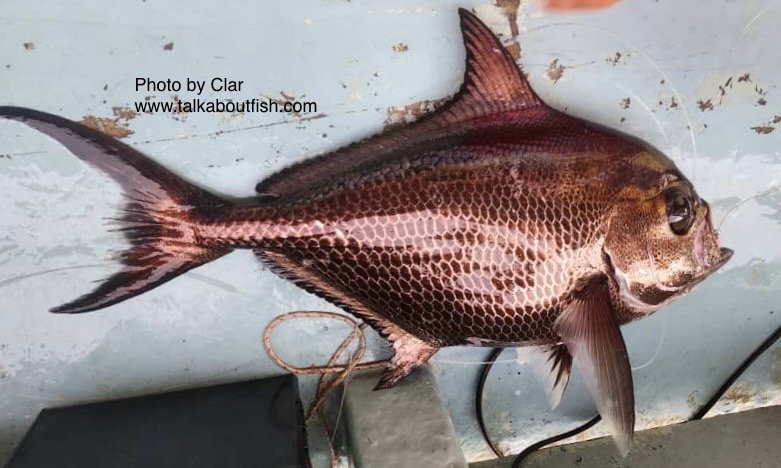
Pomfrets (Bramidae)
Overview
Pomfrets and fanfishes are pelagic marine fishes of the family Bramidae found throughout tropical and warm temperate waters of the Atlantic, Indian and Pacific Oceans. Despite their common name, pomfret, they are not closely related to the White Pomfrets (Pampus spp.) or Black Pomfret (Parastromateus niger) commonly sold in Southeast Asian markets.Pomfrets are characterised by their compressed body, strongly forked tail, falcate pectoral fins and relatively large mouth that usually extends to below the eye. Many species undergo dramatic changes in body shape and fin proportions as they grow. Juveniles of some species bear prominent spines and elongated fins that are absent or reduced in adults. Unlike the commercially important white pomfrets, members of the Bramidae possess pelvic fins and a much larger mouth adapted for capturing prey.
Pomfrets are highly migratory oceanic fishes that inhabit the open ocean from surface waters to depths exceeding 600 metres in some species. They are mid-level predators that feed primarily on small fishes, crustaceans, squids and gelatinous zooplankton such as salps. In turn, they are important prey for large oceanic predators including tunas and billfishes.
The family Bramidae consists of 7 genera and 22 species worldwide. Many are excellent food fishes and support commercial fisheries in parts of Europe and the Pacific Ocean. Five species possess greatly enlarged and fully recessible dorsal and anal fins and are commonly known as fanfishes. In the western Indo-Pacific region, 12 species have been recorded, including three fanfishes, which are occasionally encountered in offshore and oceanic habitats.
Common Pomfret Species
Scientific Name: Eumegistus illustris Jordan & Jordan, 1922
English Name: Brilliant Pomfret
Chinese Name | 鱼类中文名: 真乌鲂 (Zhēn wū fáng)
Japanese Name | 和名: チカメエチオピア (Chikame echiopia)
Main Identification Features: Body color dark-brown to black. Scales on body and head spineless. Scaleless areas above and behind the eye. Caudal fin rounded in young and juveniles, forked in adults. Caudal peduncle without a strong keel.English Name: Brilliant Pomfret
Chinese Name | 鱼类中文名: 真乌鲂 (Zhēn wū fáng)
Japanese Name | 和名: チカメエチオピア (Chikame echiopia)
Size: Maximum standard length 47 cm.
Habitat and Ecology: Benthopelagic and oceanodromous species inhabiting oceanic waters from near the surface to depths exceeding 600 m. Occurs in schools and is known to exhibit diel vertical migrations. Juveniles are pelagic, whereas adults are associated with deeper benthopelagic habitats. Little is known about its feeding biology, although members of the family Bramidae are generally predatory fishes that feed on small fishes, crustaceans, squids and gelatinous zooplankton.