Porcupinefishes
Porcupinefishes are marine fishes of the family Diodontidae found throughout tropical and subtropical seas of the Atlantic, Indian and Pacific Oceans. They are closely related to pufferfishes but are easily recognised by their long movable spines, inflatable body and powerful beak-like jaws.
Porcupinefishes are characterised by their ability to inflate themselves by swallowing water or air when threatened, causing their spines to stand erect and making them difficult for predators to swallow. Unlike pufferfishes, their teeth are fused into a single beak-like plate in each jaw rather than two plates. Most species lack pelvic fins and rely on camouflage, inflation and sharp spines for protection.
Porcupinefishes inhabit coral reefs, rocky reefs, seagrass beds and open ocean habitats from shallow coastal waters to depths exceeding 150 metres. Most species are nocturnal predators that feed primarily on hard-shelled invertebrates such as sea urchins, crustaceans and molluscs, which are crushed using their powerful jaws. Juveniles of some species are pelagic and may drift long distances with ocean currents.
Porcupinefishes are protected by both physical and chemical defences. Their inflatable body and sharp spines deter many predators, while some species contain potent toxins in their internal organs and tissues. The toxicity of porcupinefishes varies among species and geographical regions, but they are generally deemed poisonous and should not be consumed.
The common English names for members of the family include porcupinefishes, burrfishes, balloonfishes and spiny puffers. These names refer to their ability to inflate their bodies and erect their sharp spines when threatened.
There are approximately 18 species in 7 genera worldwide. In Malaysian waters, at least four species have been recorded.
Porcupinefishes are characterised by their ability to inflate themselves by swallowing water or air when threatened, causing their spines to stand erect and making them difficult for predators to swallow. Unlike pufferfishes, their teeth are fused into a single beak-like plate in each jaw rather than two plates. Most species lack pelvic fins and rely on camouflage, inflation and sharp spines for protection.
Porcupinefishes inhabit coral reefs, rocky reefs, seagrass beds and open ocean habitats from shallow coastal waters to depths exceeding 150 metres. Most species are nocturnal predators that feed primarily on hard-shelled invertebrates such as sea urchins, crustaceans and molluscs, which are crushed using their powerful jaws. Juveniles of some species are pelagic and may drift long distances with ocean currents.
Porcupinefishes are protected by both physical and chemical defences. Their inflatable body and sharp spines deter many predators, while some species contain potent toxins in their internal organs and tissues. The toxicity of porcupinefishes varies among species and geographical regions, but they are generally deemed poisonous and should not be consumed.
The common English names for members of the family include porcupinefishes, burrfishes, balloonfishes and spiny puffers. These names refer to their ability to inflate their bodies and erect their sharp spines when threatened.
There are approximately 18 species in 7 genera worldwide. In Malaysian waters, at least four species have been recorded.
Scientific Name: Diodon liturosus Shaw, 1804
English Name: Black-blotched Porcupinefish
Malay Name | Nama Melayu Malaysia: Ikan Buntal Landak, Buntal, Buntal-landak Tompok
Bahasa Indonesia: Ikan Buntel Duren, Buntal Durian, Buntal Karang
Thai Name | ชื่อสามัญภาษาไทย: ปลาปักเป้าหนามหลังแถบ (Plā pạkpêā h̄nāmh̄lạng t̄hæb)
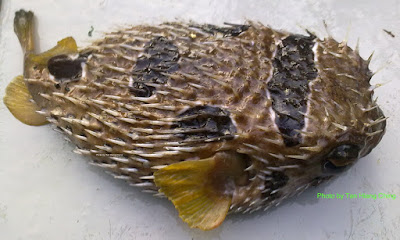
Main Identification Features: Frontal spines shorter than spines immediately behind pectoral fins. Large dorsal blotches with distinct pale border. Blotch below eye does not continue over top of head.
Size: Maximum total length 65 cm.
Habitat and Ecology: Inhabits estuaries and coral reefs to depths of at least 40 m. Usually found solitary. A nocturnal fish feeding on hard-shelled invertebrates. Sheltering in caves and ledges during the day. Capable of rapidly inflating its body by swallowing water or air when frightened or disturbed.
Remarks: Be cautious of the powerful jaws. Deemed poisonous and should not be consumed.
English Name: Black-blotched Porcupinefish
Malay Name | Nama Melayu Malaysia: Ikan Buntal Landak, Buntal, Buntal-landak Tompok
Bahasa Indonesia: Ikan Buntel Duren, Buntal Durian, Buntal Karang
Thai Name | ชื่อสามัญภาษาไทย: ปลาปักเป้าหนามหลังแถบ (Plā pạkpêā h̄nāmh̄lạng t̄hæb)
Main Identification Features: Frontal spines shorter than spines immediately behind pectoral fins. Large dorsal blotches with distinct pale border. Blotch below eye does not continue over top of head.
Size: Maximum total length 65 cm.
Habitat and Ecology: Inhabits estuaries and coral reefs to depths of at least 40 m. Usually found solitary. A nocturnal fish feeding on hard-shelled invertebrates. Sheltering in caves and ledges during the day. Capable of rapidly inflating its body by swallowing water or air when frightened or disturbed.
Remarks: Be cautious of the powerful jaws. Deemed poisonous and should not be consumed.