Archerfishes (Riflefishes)
Archerfishes (family Toxotidae) are freshwater, brackish and coastal fishes recognised by their remarkable ability to shoot jets of water at insects. They occur from India across Southeast Asia to northern Australia and Polynesia. Archerfishes are also known as riflefishes. They are distinguished by their moderately deep, compressed bodies, large eyes, dorsal fin positioned towards the rear of the body, and a moderately large, protractile mouth.
Archerfishes inhabit shallow mangrove shores, brackish estuaries, and freshwater rivers and streams, usually remaining close to the water surface beneath overhanging vegetation. They are particularly renowned for their extraordinary hunting behaviour. They can shoot jets of water with remarkable precision to knock insects off branches or from the air. Their technique involves compensating for the refraction of light at the water surface and adjusting the force and shape of the water jet according to the distance and angle of the target. The groove along the roof of their mouth and tongue forms a narrow tube that enables the powerful jet of water to be expelled with remarkable precision.
Archerfishes are usually found singly or in small schools. They feed on insects, spiders, small crustaceans and fishes. Spawning is believed to occur in coastal marine waters, where the buoyant eggs drift with currents before juveniles move into estuaries and freshwater habitats.
The family has only one genus, Toxotes, with about seven recognised species. Three species occur naturally in Malaysian waters.
Archerfishes inhabit shallow mangrove shores, brackish estuaries, and freshwater rivers and streams, usually remaining close to the water surface beneath overhanging vegetation. They are particularly renowned for their extraordinary hunting behaviour. They can shoot jets of water with remarkable precision to knock insects off branches or from the air. Their technique involves compensating for the refraction of light at the water surface and adjusting the force and shape of the water jet according to the distance and angle of the target. The groove along the roof of their mouth and tongue forms a narrow tube that enables the powerful jet of water to be expelled with remarkable precision.
Archerfishes are usually found singly or in small schools. They feed on insects, spiders, small crustaceans and fishes. Spawning is believed to occur in coastal marine waters, where the buoyant eggs drift with currents before juveniles move into estuaries and freshwater habitats.
The family has only one genus, Toxotes, with about seven recognised species. Three species occur naturally in Malaysian waters.
Scientific Name: Toxotes chatareus (Hamilton, 1822)
English Name: Spotted Archerfish, Seven-spot Archerfish, Largescale Archerfish
Chinese Name | 鱼类中文名: 查达射水鱼(Chá dá shè shuǐ yú),
Malay Name | Bahasa Melayu Malaysia: Ikan Sumpit-sumpit, Sumpit Tanda
Thai Name | ชื่อสามัญภาษาไทย: ปลาเสือพ่นน้ำ (Plā s̄eụ̄x ph̀nn̂ả)
Main Identification Features: Deep-bodied fish with an upward-pointing mouth and flattened head. Body silver with 6–7 alternating large and small black spots extending below the lateral line. Dorsal fin with 5–6 spines.
Size: Maximum total length about 50 cm, very rarely exceeding 35 cm, commonly to about 25 cm.
Habitat and Ecology: Euryhaline species inhabiting mangrove estuaries, river mouths and freshwater rivers, usually found beneath overhanging vegetation, solitary or in groups. Relies heavily on vision to detect prey. Feeds mainly on crustaceans (crabs and shrimps) and insects. Insects are either knocked into the water with jets of water or captured directly from the surface.

Scientific Name: Toxotes jaculatrix (Pallas, 1767)
English Name: Banded Archerfish, Northern Riflefish
Chinese Name | 鱼类中文名: 射水鱼(Shèshuǐ yú),
Malay Name | Bahasa Melayu Malaysia: Ikan Sumpit-sumpit, Sumpit Belang
Thai Name | ชื่อสามัญภาษาไทย: ปลาเสือพ่นน้ำน้ำกร่อย (Plā s̄eụ̄x ph̀nn̂ả n̂ảkr̀xy)
Main Identification Features: Snout angular with lower jaw protruding. Dorsal head flattened. Single dorsal fin situated far back on body with 4 stout dorsal spines. 4 or 5 dark black bars on upper side.
Size: Maximum total length about 30 cm, commonly to about 20 cm.
Habitat and Ecology: A euryhaline species inhabiting primarily brackish mangrove habitats, but also found in freshwater and coastal waters. In groups or solitary. Prefers areas with over-hanging vegetation. Relies heavily on vision to detect prey. Feeds mainly on crustaceans (crabs and shrimps) and insects. Insects are either shot down or taken as they float on the surface of water.

English Name: Spotted Archerfish, Seven-spot Archerfish, Largescale Archerfish
Chinese Name | 鱼类中文名: 查达射水鱼(Chá dá shè shuǐ yú),
Malay Name | Bahasa Melayu Malaysia: Ikan Sumpit-sumpit, Sumpit Tanda
Thai Name | ชื่อสามัญภาษาไทย: ปลาเสือพ่นน้ำ (Plā s̄eụ̄x ph̀nn̂ả)
Main Identification Features: Deep-bodied fish with an upward-pointing mouth and flattened head. Body silver with 6–7 alternating large and small black spots extending below the lateral line. Dorsal fin with 5–6 spines.
Size: Maximum total length about 50 cm, very rarely exceeding 35 cm, commonly to about 25 cm.
Habitat and Ecology: Euryhaline species inhabiting mangrove estuaries, river mouths and freshwater rivers, usually found beneath overhanging vegetation, solitary or in groups. Relies heavily on vision to detect prey. Feeds mainly on crustaceans (crabs and shrimps) and insects. Insects are either knocked into the water with jets of water or captured directly from the surface.
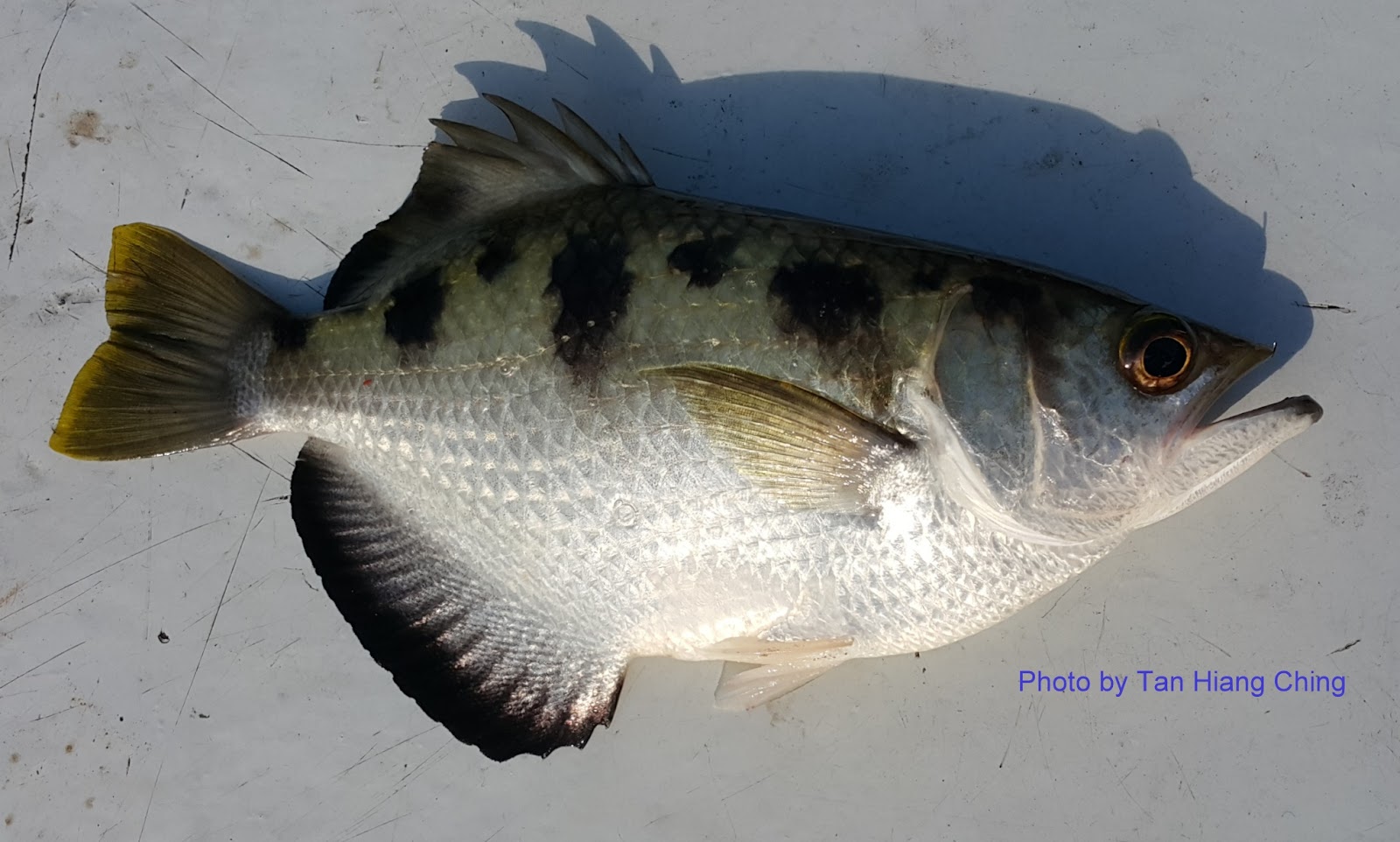
Scientific Name: Toxotes jaculatrix (Pallas, 1767)
English Name: Banded Archerfish, Northern Riflefish
Chinese Name | 鱼类中文名: 射水鱼(Shèshuǐ yú),
Malay Name | Bahasa Melayu Malaysia: Ikan Sumpit-sumpit, Sumpit Belang
Thai Name | ชื่อสามัญภาษาไทย: ปลาเสือพ่นน้ำน้ำกร่อย (Plā s̄eụ̄x ph̀nn̂ả n̂ảkr̀xy)
Main Identification Features: Snout angular with lower jaw protruding. Dorsal head flattened. Single dorsal fin situated far back on body with 4 stout dorsal spines. 4 or 5 dark black bars on upper side.
Size: Maximum total length about 30 cm, commonly to about 20 cm.
Habitat and Ecology: A euryhaline species inhabiting primarily brackish mangrove habitats, but also found in freshwater and coastal waters. In groups or solitary. Prefers areas with over-hanging vegetation. Relies heavily on vision to detect prey. Feeds mainly on crustaceans (crabs and shrimps) and insects. Insects are either shot down or taken as they float on the surface of water.