Devil Rays and Manta Rays
Devil rays and manta rays are large marine rays recognised by their horn-like cephalic fins. They occur in tropical and warm-temperate oceans worldwide, inhabiting coastal waters as well as the open ocean. They have broad, wing-like pectoral discs and enormous forward-facing mouths. Unlike most rays, they spend much of their lives swimming in mid-water rather than resting on the seabed.
Both devil rays and manta rays belong to the cartilaginous fish family Mobulidae. Manta rays are the two largest members of the family and are distinguished from the other devil rays mainly by their much larger size and terminal (forward-facing) mouth, whereas most other devil rays have a subterminal mouth. Although manta rays were formerly placed in a separate genus (Manta), under the current classification all manta rays and devil rays belong to the single genus Mobula.
Devil rays and manta rays are among the most graceful swimmers in the ocean, propelling themselves through the water with slow, powerful beats of their wing-like pectoral fins. Many species, including manta rays, frequently leap completely out of the water. The cephalic fins on either side of the mouth are unfurled during feeding to funnel plankton-rich water into the mouth.
Unlike eagle rays, cownose rays and stingrays, devil rays and manta rays feed by filtering plankton, small fishes and crustaceans from the water using specialised gill plates. Their tiny teeth play little role in feeding. They also have one of the lowest reproductive rates of any fish, usually producing only a single well-developed pup after a long gestation period, making them especially vulnerable to overfishing.
The family Mobulidae contains a single genus, Mobula, with about ten recognised species. Two species occur naturally in Malaysian waters.
Both devil rays and manta rays belong to the cartilaginous fish family Mobulidae. Manta rays are the two largest members of the family and are distinguished from the other devil rays mainly by their much larger size and terminal (forward-facing) mouth, whereas most other devil rays have a subterminal mouth. Although manta rays were formerly placed in a separate genus (Manta), under the current classification all manta rays and devil rays belong to the single genus Mobula.
Devil rays and manta rays are among the most graceful swimmers in the ocean, propelling themselves through the water with slow, powerful beats of their wing-like pectoral fins. Many species, including manta rays, frequently leap completely out of the water. The cephalic fins on either side of the mouth are unfurled during feeding to funnel plankton-rich water into the mouth.
Unlike eagle rays, cownose rays and stingrays, devil rays and manta rays feed by filtering plankton, small fishes and crustaceans from the water using specialised gill plates. Their tiny teeth play little role in feeding. They also have one of the lowest reproductive rates of any fish, usually producing only a single well-developed pup after a long gestation period, making them especially vulnerable to overfishing.
The family Mobulidae contains a single genus, Mobula, with about ten recognised species. Two species occur naturally in Malaysian waters.
Scientific Name: Mobula kuhlii (Müller & Henle, 1841)
English Name: Shortfin Devil Ray, Lesser Devilray
French Name: Petit diable
Chinese Name | 鱼类中文名: 库氏蝠鲼 (Kù shì fú fèn), 短角侏儒魔鬼魚 (Duǎn jiǎo zhū rú mó guǐ yú), 魔鬼鱼 (Móguǐ yú)
Malay Name | Nama Melayu Malaysia: Ikan Pari, Pari Paus Tanpa Duri, Pari Kelawar, Pari Kalok
Thai Name | ชื่อสามัญภาษาไทย: ปลากระเบนปีศาจครีบสั้น (Plāk ra ben pīṣ̄āc khrīb s̄ận)
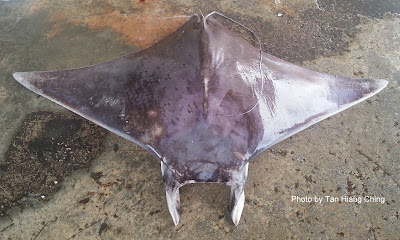
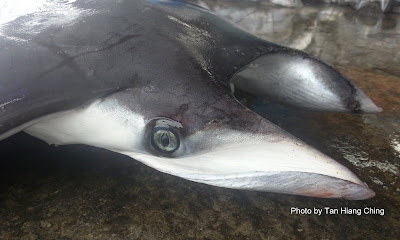
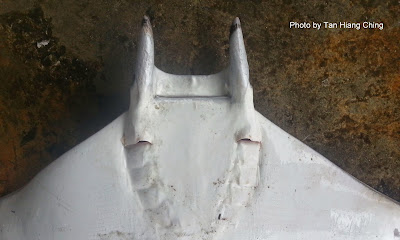
Main Identification Features: Dorsal fin with a white spot at apex. Cephalic fin relatively short, less than 16% of disc width. Pectoral fins with slightly curved tips. Front margin of the pectoral fins slightly convex and not undulated. Dark brown above, white below.
Size: Maximum 120 cm disc width. Born at about 31 cm disc width. Males mature at about 115 cm disc width.
Habitat and Ecology: Coastal and oceanic waters. Usually found in schools. Capable of leaping out of the water. Feeds mainly on planktonic crustaceans, but also small fishes and cephalopods. Very low reproductive rate (typically one pup per pregnancy).
Conservation Status: Listed as Endangered on the IUCN Red List.


English Name: Shortfin Devil Ray, Lesser Devilray
French Name: Petit diable
Chinese Name | 鱼类中文名: 库氏蝠鲼 (Kù shì fú fèn), 短角侏儒魔鬼魚 (Duǎn jiǎo zhū rú mó guǐ yú), 魔鬼鱼 (Móguǐ yú)
Malay Name | Nama Melayu Malaysia: Ikan Pari, Pari Paus Tanpa Duri, Pari Kelawar, Pari Kalok
Thai Name | ชื่อสามัญภาษาไทย: ปลากระเบนปีศาจครีบสั้น (Plāk ra ben pīṣ̄āc khrīb s̄ận)
Main Identification Features: Dorsal fin with a white spot at apex. Cephalic fin relatively short, less than 16% of disc width. Pectoral fins with slightly curved tips. Front margin of the pectoral fins slightly convex and not undulated. Dark brown above, white below.
Size: Maximum 120 cm disc width. Born at about 31 cm disc width. Males mature at about 115 cm disc width.
Habitat and Ecology: Coastal and oceanic waters. Usually found in schools. Capable of leaping out of the water. Feeds mainly on planktonic crustaceans, but also small fishes and cephalopods. Very low reproductive rate (typically one pup per pregnancy).
Conservation Status: Listed as Endangered on the IUCN Red List.